Skip to content
Richmond Foundation Repair

Serving Richmond and nearby areas

House Settling in Richmond, VA

Some settling is normal for any Richmond house, but settling that keeps going is a foundation problem, and a free inspection tells you which one you have.

Book a free foundation inspection

Tell us what you are seeing. A local specialist calls you back the same business day.

Local to Richmond

We connect property owners in Richmond and nearby areas, including The Fan, Museum District, Church Hill, Shockoe Bottom, Ginter Park and Woodland Heights, with one independent local foundation repair specialist.

  • A city on the fall line

    Richmond sits on the fall line, a zone about seven miles wide here, where shallow Piedmont bedrock meets the loose sediments of the Coastal Plain. Ground under one house can be very different from ground a few streets away.

  • Soil reports for new homes

    Chesterfield County asks for a sealed soils report on every new single-family home. Henrico requires one where its maps show moderate or high shrink-swell soil. Homes built before those rules had no such check.

  • Coal under Midlothian

    Western Chesterfield sits on the Richmond Basin, an old rock basin with coal seams. Virginia's state energy department counts about 40 historic coal mines in the Midlothian area.

What it costs

Typical published ranges for Richmond. The contractor's written estimate is the price, and the inspection is free.

WorkTypical range
Most foundation repairs, national range $2,200 to $8,200
Minor repairs in Richmond, like crack repair $2,100 to $4,200
Major repairs in Richmond, like piers and underpinning $2,500 to $26,400
Piers, each $1,000 to $3,000
Crack sealing or injection $200 to $1,000

See typical foundation repair prices in Richmond

What normal settling looks like

Every house settles a little. The soil under a new house packs down under its weight, and new wood dries and shrinks. In an older house, small shifts keep happening, just very slowly. These signs are usually normal.

Hairline cracks in drywall,

About the width of a hair, often at the corners of doors and windows.

Small cracks where the ceiling meets the wall,

In the first year or two of a new house.

Nail pops,

Small round bumps where drywall nails push out.

Thin cracks in a garage slab

Or driveway that do not grow and stay flat.

Creaks and pops at night,

From wood and ducts moving with temperature.

One home builder's guide calls cracks of a sixteenth of an inch or less normal and common in new homes. Settling is most noticeable in the first few years and slows after that.

What is not just settling

The line between settling and a foundation problem is simple to say: normal settling is small, even, and it stops. A problem is uneven, and it keeps going. These signs point to more than settling.

Cracks wider than about an eighth of an inch,

Or cracks that grow.

Stair-step cracks

In brick or block.

Horizontal cracks

In a foundation wall.

Cracks that come back

After you patch them.

Doors and windows that stick

All year, not just in summer.

Floors that slope

More each year.

Gaps that open

Between walls and ceilings, or at a porch or chimney.

Cracks inside that line up

With cracks outside.

A guide from the National Association of Realtors says horizontal and diagonal cracks should be looked at by a pro whatever their width, and that a cluster of cracks in one area also calls for attention.

Why houses settle unevenly in Richmond

Two kinds of ground meet here. Richmond sits on the fall line, a zone about seven miles wide in Richmond, where shallow Piedmont bedrock to the west meets the loose sediments of the Coastal Plain to the east. One end of a house can sit on firmer ground than the other. That is how settling turns uneven.

Clay that swells and shrinks. Henrico County requires a soils report for new homes and additions where its maps show moderate or high shrink-swell soil. Chesterfield County asks for a sealed soils report on every new single-family home. Soil that swells when wet and shrinks when dry can lift and drop one part of a house again and again.

Rain all year. Richmond averages about 43.6 inches of rain a year. A downspout that dumps by one corner keeps that soil wetter than the rest. Over time, that one corner settles more.

Old fill and old mines. Some lots were filled and leveled before building, and loose fill keeps packing down for years. In western Chesterfield, the Midlothian area sits over the old Richmond coal basin. Mine problems under homes are rare, but they are a reason the inspector wants to know what is under your lot.

Old houses, no soil checks. About 29 percent of homes in the city of Richmond were built before 1940, long before the county soil report rules. Nobody checked the soil under them.

When to act

Watch and track:

  • Hairline cracks in a house less than a few years old
  • Old cracks that have not changed

Have it inspected:

  • Any crack that grows over a few months
  • Settling signs in a house more than five years old that are new
  • Two or more of the signs in the list above at once

Call soon:

  • A crack that is growing fast or one side sitting higher than the other
  • A door that suddenly will not close
  • A floor that drops in one spot

What the fix usually is

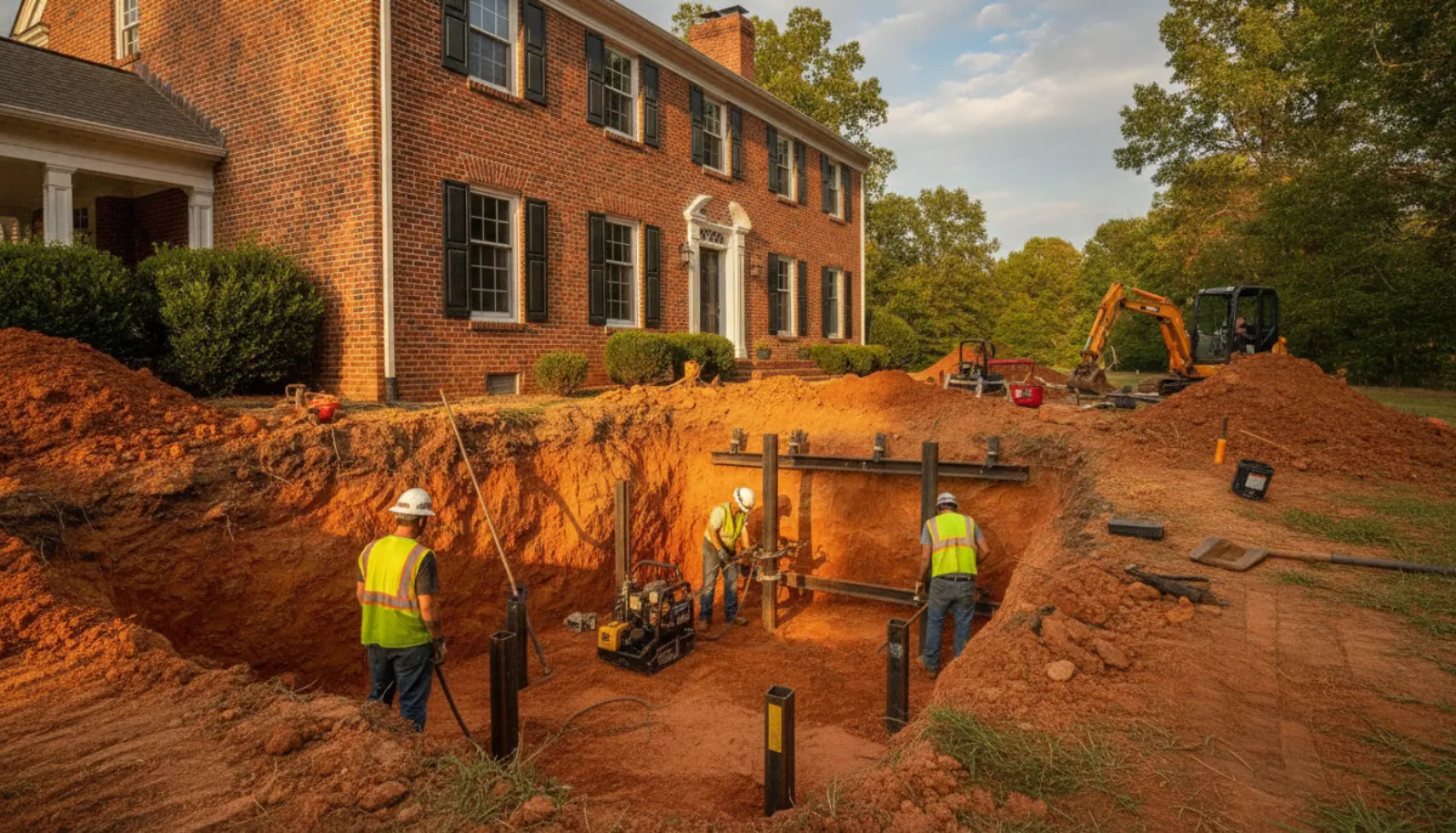
If the house is still settling unevenly, the usual fix is to support the part that is dropping. Steel push piers or helical piers are placed under that wall or corner and reach down to firmer soil. In a crawl space home, new support posts may go under the beams instead. Then water is moved away from the house so the soil stays even. Cracks are sealed after the house is stable, not before.

The prices in the table are typical published ranges from Fixr and HomeBlue, not a quote. The number of piers is what moves the price the most.

What to do before the inspection

  1. Mark and date each crack with a pencil at both ends.
  2. Photograph cracks with a coin or ruler beside them.
  3. Check again in a month to see if anything grew.
  4. Find your paperwork. For a newer home, find the builder warranty and any soils report.
  5. Walk the outside after rain and note where water pools.

Call (804) 293-2238 or send the short form. A local crew will measure your floors, look at every crack, and tell you whether it is normal settling or something to fix, with a written price.

Frequently asked questions

How long does it take a new house to settle?

Most settling in a new home happens in the first few years, with the most in the first year or so. After that it should slow to almost nothing. A new home that keeps cracking after a few years may be moving for another reason.

Is it normal for an old house to keep settling?

Older homes keep settling, but very slowly. A 100-year-old Richmond house should not be getting new cracks every year. If it is, something has changed, often water or a failing pier.

Are hairline cracks in drywall normal?

Thin cracks about the width of a hair, often at the corners of doors or where drywall sheets meet, are common as a house settles and as wood dries out. Watch for cracks that get wider, longer or come back after you patch them.

My house creaks and pops at night. Is it settling?

Usually not. Creaks and pops are most often wood and ducts growing and shrinking as the temperature changes. They are not a sign of foundation trouble on their own.

What is the difference between settling and sinking?

Settling is small, even, and stops. Sinking is when one part of the house drops more than the rest and keeps dropping. Uneven, ongoing movement is what cracks walls and jams doors.

Does my new home warranty cover settling?

It depends on the builder's warranty. Many cover structural defects for a set number of years but not cosmetic cracks. Read the warranty and report problems in writing before it runs out.

(804) 293-2238 Free inspection